What temperature measures
A small cup of water and a large bath can have the same temperature while containing very different amounts of energy. Put them in thermal contact, with their temperatures initially equal, and neither should systematically heat the other. Whatever temperature measures, it must distinguish the amount of energy a body contains from the way that body responds when energy is exchanged.
Consider a model in which the accounting is completely visible. Energy comes in units of size , distributed among labelled cells. A cell may hold zero units, one, two, or any larger nonnegative number. The energy of a configuration is times the sum of its occupancies. The cells can represent idealized modes with equally spaced energy levels; for now their only relevant properties are those we have specified.
Divide them into two groups, A and B, and allow energy to pass between the groups while keeping the total fixed. There is no exchange of particles and no moving boundary doing mechanical work. If A gains one unit, B loses one. The changing quantities are the two stored energies; the transfer connects them through that conservation law.
Counting the ways to share energy
With three cells and two energy units, a configuration is a list such as or . There are six possibilities: three put both units in one cell, and three place one unit in each of two cells. The cells are distinguishable; the energy units themselves carry no individual labels.
The number of configurations for cells containing units is
The symbol on the right counts choices of positions among . To see why it appears, write the energy units in a row and insert dividers. The units before the first divider belong to the first cell, those between the first two dividers to the second, and so on. Adjacent dividers represent empty cells. Every choice of divider positions describes exactly one configuration.
Suppose A contains twenty cells, B sixty, and the total energy is forty units. If A has units, B has . Each configuration of A can be paired with every compatible configuration of B. The number of complete configurations with this split is therefore
If complete configurations at fixed total energy have equal equilibrium probabilities, the probability of the split is proportional to . Dividing by the sum of all the weights makes the probabilities add to one. Equal probability for complete configurations does not mean equal probability for different energy splits: some splits can be realized in many more ways.
For this model, an explicit dynamics can justify the equal weights. Choose any pair of distinct cells uniformly, collect their combined number of units, and redistribute that total uniformly among the possible splits between the two cells. Every permitted transition has the same probability as its reverse. Repeated moves can connect all configurations with the prescribed total, and some moves leave a configuration unchanged. The resulting finite Markov chain converges to the uniform distribution. This distribution over configurations at fixed total energy is the microcanonical ensemble. This is one possible exchange rule; it is not a derivation of how a real material transfers heat.
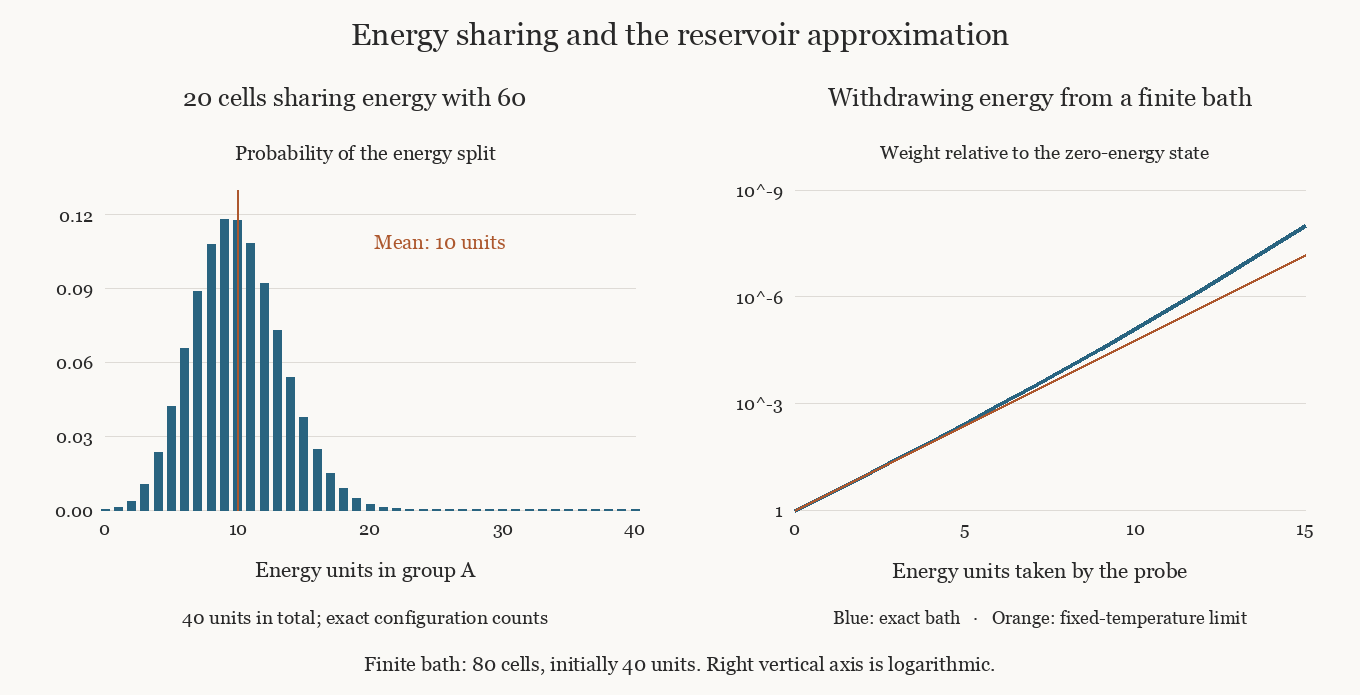
The left panel shows the exact distribution of energy in A. Its mean is ten units, leaving thirty for B. Every cell has the same expected occupancy, so the larger group receives more energy. The most probable split is nine units in A and thirty-one in B; for a system this small, a mean and a most probable value need not coincide. Equal energies, twenty units in each group, lie well into the tail of the distribution. The fluctuations around the preferred range are also visible: equilibrium permits continuing exchanges.
The quantity that becomes equal
We can locate a preferred split without comparing huge products directly. Define the entropy associated with a given energy by
Here is Boltzmann's constant, with units of energy per kelvin, and the logarithm turns multiplication of configuration counts into addition. The logarithm of is thus proportional to the sum of the entropies of the two groups at that split.
Imagine transferring a small amount of energy from B to A. If entropy can be treated as a smooth function of energy, its total change is approximately
A derivative here is a slope: how much the entropy changes per small additional amount of energy, with the number of cells and other constraints held fixed. A transfer towards the steeper slope increases the total entropy, because the gain in available configurations on the receiving side outweighs the loss on the other side.
At an interior maximum, the two slopes are equal. Statistical mechanics identifies this slope with inverse absolute temperature:
The subscripts specify fixed volume and particle number for a material system. They matter: allowing expansion or particle exchange would introduce additional terms. In the present cell model we keep the number of cells and their energy spacing fixed.
For two ordinary bodies at positive temperatures, a small transfer from the hotter body to the colder one gives a positive total entropy change, since the colder body's inverse temperature is larger. That establishes the statistically favoured direction near equilibrium. It does not determine a transfer rate, and it does not prohibit temporary fluctuations in the opposite direction. Stability also matters: equality of slopes identifies a stationary split, while a maximum requires the total entropy to curve downward there.
For our cells, adding one energy unit multiplies the number of configurations by . At large and , with their ratio fixed, the corresponding entropy slope gives
Temperature therefore depends on energy per cell, rather than total energy alone. Increasing raises the temperature, while increasing both and by the same factor leaves it unchanged in this limit. The smooth derivative is a macroscopic approximation; the finite counts used in the figure remain exact.
Why a reservoir produces an exponential
Now let A be a small system and B a much larger reservoir. Fix one particular microscopic state of A, with energy . There is no further count of A's possibilities: we have specified its state completely. The compatible complete configurations are counted by the reservoir alone, which has energy . Hence
Choose the small system's lowest energy as zero. If the energy it extracts hardly changes the reservoir's entropy slope, the reservoir entropy can be approximated by a straight line over the relevant range:
Using then gives
This distribution at fixed temperature is the canonical ensemble. The sum , called the partition function, normalizes the probabilities. The exponential is the Boltzmann weight. Its origin is the number of reservoir configurations compatible with a particular system state. Raising the system's energy reduces the reservoir's energy, and the reservoir's entropy slope determines how strongly that change reduces the statistical weight.
The right panel tests the approximation using a reservoir of eighty cells initially holding forty units. A specified state of a small probe with energy leaves the reservoir with units. The exact weight relative to the probe's zero-energy state is . A reservoir whose slope stayed at its macroscopic initial value would instead give . The agreement is close for small withdrawals; extracting a substantial share of the reservoir's energy makes the fixed-temperature approximation fail. On the logarithmic vertical axis, a pure exponential is a straight line, while the finite reservoir bends away from it.
What a thermometer samples
An ideal two-level probe makes this relation measurable. Suppose it has one state at energy zero and one at energy , and equilibrates weakly with a reservoir. In the regime where the reservoir maintains its temperature, the ratio of the excited-state probability to the ground-state probability is . Measuring that ratio and knowing the energy gap allows us to infer the reservoir's temperature. The probe must exchange energy enough to equilibrate while remaining small enough not to appreciably change the reservoir.
The qualification about one state at each energy is essential. If an energy level contains several distinct states, its total probability is the sum of their Boltzmann weights. A higher energy can have a substantial total probability because many microscopic states share it. Energy preference and multiplicity enter together; selecting only the lowest-energy configuration would generally miss thermal equilibrium.
The familiar relation between temperature and molecular motion is a consequence for particular systems. Here the same temperature has been defined through energy sharing and measured through level populations, without assigning a speed to any cell. What the reservoir supplies is a relation between energy differences and relative probabilities. Its composition can change, while a sufficiently small equilibrated probe continues to read that relation through the same exponential law.
Letture collegate
Come la copia locale cambia le statistiche congiunte e perché una correlazione non identifica la sua causa.
6 min di letturaProbabilità stazionarie, tempi di mixing e limiti imposti dalle correlazioni a una lunga osservazione.
7 min di lettura